The Thorny Devil Lizard
Also called Moloch, Horny Devil, Thorny Lizard, Thorny Dragon
Thorny Devils (Moloch horridus) are another popular example of the Australian lizards that live in the Outback.
The devils belong to the family Agamidae, also known as dragon lizards.
Not only is the thorny devil one of the most unusual looking reptiles, it also has rather unusual eating and drinking habits.
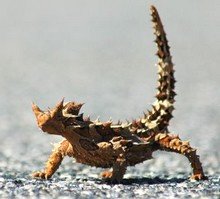 And despite its dangerous appearance and its name it is also one of the least aggressive reptiles. It relies on camouflage and on its ingenious way of self-defence (see below).
- Thorny Devil Facts
- How do Thorny Devils drink?
- What do Thorny Devils eat?
- How do they defend themselves?
Thorny Devil Facts
- The thorny devil (Moloch Horridus) is the sole species in its genus (Moloch).
- The lizard was named by the botanist Dr. John Grey, after the Caanite god Moloch (to whom children were sacrificed!). Horridus has two meanings in Latin: it stands for rough and bristly, which the thorny devil certainly is. The second meaning is dreadful, which it isn't. (But you can't blame the people who first saw one for thinking it is...) Its name certainly belies the gentle nature of this small and harmless creature.
- Australian thorny devils are only very distantly related to the American horned lizards, but they do have similarities: both have spiny heads, and both are ant-eaters. (Our devil is much spinier all over.) It is interesting that horned lizards and thorny devils are anatomically a lot closer to each other than they are to their own closest relatives.
- The habitat of the thorny devil are the dry inland regions of Outback Australia and the south western coast. Its distribution seems to be determined more by soil type (it likes sand and sandy loam) than by climate or anything else. (If you are hoping to see one on your travels, good luck. They are very hard to find.)
- Thorny lizards are heliotherm, meaning they need sunlight to warm themselves up, and their body temperature and agility depends on the outside temperature. They are most active during spring and autumn, but move very little during the hottest (Jan/Feb) or coldest months (June/July). During their active months they spend the nights and the midday heat under some protective cover.
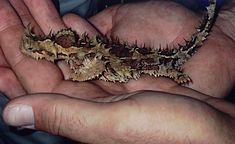
- Thorny devils only grow to about 20 cm in size (including the tail).
The females are slightly bigger than the males.
They keep growing for at least five years and are thought to live for up to 20 years.
- The lizard is a slow moving creature. When it walks it lifts its tail and slowly sways from one side to the other.
- A thorny lizard is mature at three years of age. Mating occurs around August/September. In that time the usually sedentary lizard will travel considerable distances to meet a mating partner. After mating, from mid September through to December, the female lays three to ten eggs in a burrow, which she excavates with her hind feet over several days. She then backfills the tunnel, leaving an air filled chamber. The young lizards hatch after three to four months and seem to eat their eggshells before they dig their way out of the chamber.
Thorny Devils - Drinking
The skin of a thorny lizard is totally impervious. That means it doesn't sweat or lose any water via its skin. It doesn't need much, but it needs to drink some water.
The way thorny devils drink water is ingenious, an amazing adaptation to life in the harsh desert environment. Their body is covered in a system of tiny grooves or channels that run between their scales. All the channels lead to the corners of their mouth. These channels absorb water via capillary action. (If you put a very thin straw into water some water will rise up in the straw above the water level. That's capillary action.)
Not only can the thorny lizard capture rain this way, it can also absorb dew drops, for example from the vegetation it moves through, via the capillaries. Once the water is in the grooves the lizard can suck it towards its mouth by gulping. What a design! Perfect for the desert environment.
Thorny Devils - Eating
The way thorny devils eat is unusual as well.
Their diet doesn't have much variety: they eat ants, nothing but ants, preferably one particular kind of ant, a small black ant called Iridomyrmex flavipes (Although they do eat a few other ant species as well, if they can't find any Iridomyrmex.)
When a thorny devil wants to eat it sits at the ant trail, waits for the ants to pass and then flicks them up with its sticky tongue.
One little ant at a time! You can see it in the video.
(Though not very well. It's hard to see the ants, but every time the thorny lizard moves its head it's flicking up an ant.)
The video shows a lizard in captivity. It's not very hungry by the looks of it. Thorny lizards can eat much faster than that. They can flick up 45 ants a minute if they want to. Nobody counted exactly how many ants they eat in a single meal, but the estimates range from 1000 to 3000 ants.
Thorny Devils - Defence Mechanisms?
The thorny devil's initial line of defence is its camouflage.
Their colours are usually a pale yellow and read (that's when they are warm and active), perfect in the desert sands. When the lizard is cold it is a dark olive. It can also rapidly change colour when it is alarmed. When walking, the lizard may freeze suddenly, often with one leg in the air, presumably to make it harder to see.
But the best defence of the thorny lizard are the many sharp spines that cover its body.
If the lizard feels threatened it can tuck its head between its legs and expose a "false head", a very spiny, knob like appendage on its back.
(Interestingly all the spines, including the false head, are entirely boneless, whereas horned lizards have bony spines).
This knob is filled with only fatty tissue. It would be very hard for any animal to swallow the lizard now, but even if a predator tried it would only damage that knob, and not the real head or any vital parts.
Initially it was thought that the thorny devil would "sacrifice" this knob when it is attacked, a bit like other lizards can drop their tail. But nobody has ever seen a thorny devil without the false head. They have, however, been seen with humps that were damaged as if something had chewed on them.
Well, the fact is that despite its looks and spines the thorny devil often falls prey to other animals, mainly bustards and goannas. Goannas also find and dig up the eggs of the thorny devils. And then there are the feral cats... No small Australian animal is safe from them.
But the worst threat the thorny devil faces is not from other animals, it's from humans and is the same as always...
Habitat destruction, habitat destruction, habitat destruction.
Read about other Australian Lizards | Return to top


